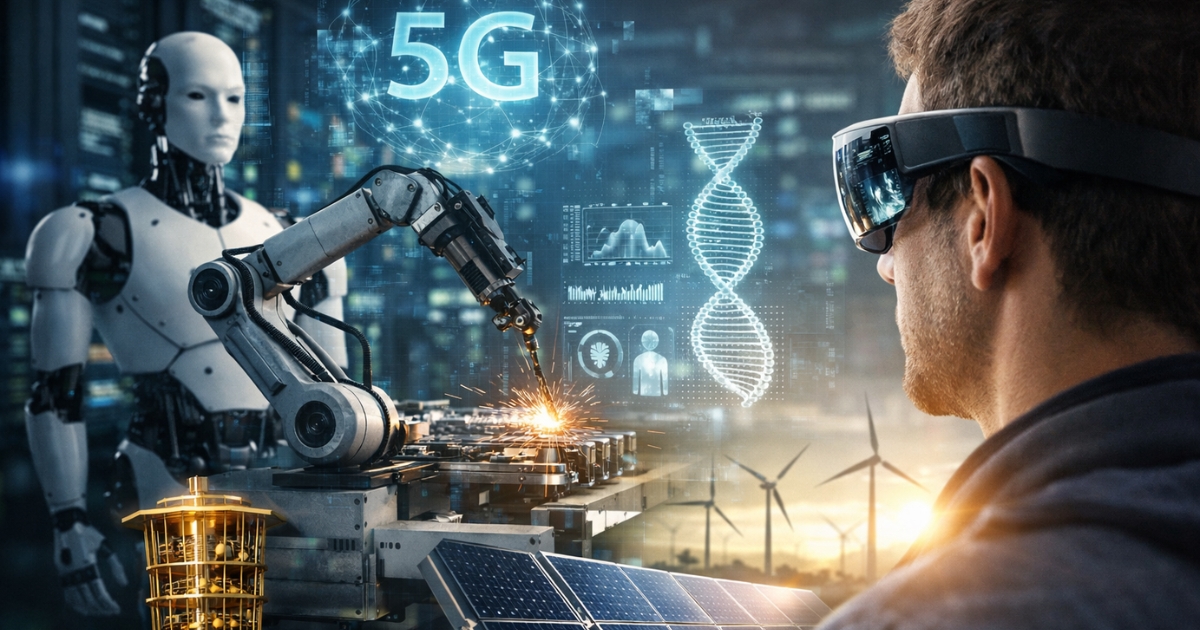
Technological innovations are only getting faster and the 2026 future of technology looks like RoarTechMental is the pioneer in the game. Technology is transforming our lifestyles, livelihoods, and overall interaction patterns, starting with artificial intelligence that is an autonomous entity to sustainable computing solutions to environmental problems. To keep up with these emerging trends, businesses, governments, and individuals have to be aware of them. Knowing about such innovations, organizations will be able to implement strategies that would bring forth the most efficiency, minimize risks, and develop new opportunities. This paper gives a detailed discussion of technology trends in 2026, how they will be applied in practice in the real world, statistics and practical implementation plan.
Evolution of Artificial Intelligence
Nevertheless, the realm of AI remains predominant in the technological arena, yet in 2026, a new level of sophistication of AI will be experienced. According to RoarTechMental trends, there are three key sectors of AI innovation, namely agentic AI, physical AI, and domain-specific language models.
Multimodal Systems Agentic AI
Traditional AI has been cursed with being reactive instead of agentic but agentic AI works independently. These systems are able to reason, execute and plan multi-complex tasks without human intervention. Multimodal AI combines several types of data text, images, audio, and video which give it the ability to make detailed decisions in real-time. This is changing the nature of the finance, logistics, and healthcare industries.
Scenario: An agentic AI within a supply chain is able to identify a disruption, calculate alternative paths, and make orders with suppliers (without human intervention).
Statistical Insight: Gartner estimates that by 2026 more than 40% of enterprise AI implementations will be based on agentic AI with the ability to execute tasks independently, as compared to the current 15 percent in 2024.
Physical Artificial Intelligence and Humanoid Robots
The physical robot-embodiment of AI is the next frontier as it will come in the form of humanoid and collaborative robots. Such systems integrate machine learning with robotics to navigate, sense, and respond to the real world.
Example: Humanoid robots are being implemented at warehouses to select, pack and sort goods effectively, saving labor expenses and enhancing speed of operations. The use of AI-controlled robots in healthcare is used to monitor patients, work with the elder population, and even during surgery.
Market Perspectives: ABI Research believes that the humanoid robot market in the world will have up to 15 billion dollars in the not distant future, and logistics and healthcare are the first to be adopted.
Domain Specific Model-of-Language
Basic AI models are being replaced with domain-specific language models, which are specialized to specific industries such as finance, legal services, and healthcare. These models give contextual insight contributing to accuracy and relevance of decisions made.
Example: An AI tool applied to contracts can scan them and identify risks, as well as propose changes, saving time previously spent by human lawyers.
Actionable Insight: Organizations that implement domain-specific AI have found 30–50% higher accuracy in tasks than generic AI models.
Intel Infrastructure and Advances in Security
The future (2026) of AI and digital platforms demands well-developed infrastructure and active security. AI supercomputing, proactive cybersecurity, and confidential computing will be used to provide safe and scalable technology implementations.
Artificial Intelligence Supercomputing and Specialized Chips
Expanding AI workloads have driven the need to use high-performance computing and AI-focused chips. Firms such as NVIDIA and AMD are still innovating and developing energy-efficient processors that can be used to execute complex AI tasks.
Examples: AI supercomputers are utilized in drug discovery, climate modeling, and real-time language translation. They also save time taken weeks to make decisions.
Statistic: NVIDIA AI-oriented GPUs have enhanced deep learning performance by more than 100 percent over the past two years.
Preemptive Cybersecurity
Cyber threats are increasingly becoming advanced with the adoption of AI. In preemptive cybersecurity systems, AI is used to scan networks on the fly and identify anomalies and counter threats before they become a problem.
Top Secret Computers and Data Security
Data privacy is leaving storage and transmission behind. Confidential computing enables organizations to operate sensitive data safely while it remains encrypted, complying with data privacy regulations.
Sample: Healthcare organizations can perform patient analytics using encrypted datasets, ensuring privacy while providing actionable insights.
Digital-Physical Convergence
Technology is also becoming a boundary-spanner between the virtual and the real. This convergence is brought by spatial computing, smart glasses, edge computing, and next-gen networks.
Spatial Computing and Smart Glasses
AR and VR are leaving the gaming industry and finding their way into real-world applications in education, manufacturing, and healthcare. Lightweight immersive devices facilitate real-time overlays, teamwork, and practical training.
Edge Computing with 5G and 6G
Edge computing works close to the data source, lowering latency and enhancing efficiency in IoT devices, autonomous vehicles, and smart cities. Combined with 5G and upcoming 6G networks, it allows real-time decision-making.
Future Tech and Sustainability
Sustainable technology is no longer a choice: it is a strategic imperative. Responsible innovation is being influenced by green computing, quantum computing, and digital provenance.
Green Computing
Green systems are emerging as a concern. Measures include low-power processors, environmentally friendly data centers, and innovative cooling technologies.
Example: Google’s new data centers are 50 times more energy-efficient thanks to liquid cooling and AI-based workload management.
Quantum Computing
Quantum computing is gaining momentum in encryption, complex simulations, and drug discovery. It offers unprecedented computational capabilities for problems previously unsolvable.
Blockchain and Digital Provenance
Blockchain ensures digital content is authentic, combating misinformation, deepfakes, and fraud. Digital provenance is critical for media, supply chains, and intellectual property.
Use case: Artists can authenticate digital artworks to verify originality and ownership.
New Health and Social Trends
Technology is changing health, mental wellness, and societal behavior. Concepts like AI-enhanced healthcare and digital minimalism are becoming everyday trends.
Artificial Intelligence Health and Mental Care
Physical and mental health can be monitored in real time by wearables. AI offers individualized guidance on stress, sleep, and mental health.
Examples: AI-driven mental health apps provide coping mechanisms and behavior analysis with real-time biofeedback.
Statistic: AI health tech will surpass 50 billion dollars by 2026 due to growth in wearables and remote monitoring.
Digital Minimalism
Digital overload is a growing concern. Digital minimalism encourages conscious device use, mental clarity, and work-life balance.
Example: Minimalist applications reduce notifications, allowing users to focus on key tasks without losing connectedness.
FAQs
What are the most influential technology trends in 2026?
The evolution of AI, digital-physical convergence, sustainable computing, quantum computing, and AI-driven healthcare.
What can businesses do with agentic AI?
By adopting AI systems, businesses can plan and execute operations autonomously, enhancing efficiency and minimizing errors.
What is the importance of confidential computing?
It enables secure processing of data in encrypted form, ensuring privacy and regulatory compliance.
How does digital minimalism impact technology adoption?
It minimizes digital overload and enhances focus and productivity by encouraging conscious use of devices.
Summary Maintain Leadership with RoarTechMental Trends
The new technology trend RoarTechMental is redefining industries, society, and daily life. Autonomous AI, humanoid robots, green computing, and quantum innovations present opportunities for businesses and individuals to succeed.
These trends can be learned, embraced, and incorporated within organizations to enhance efficiency, security, and competitiveness in a digitalized world.