
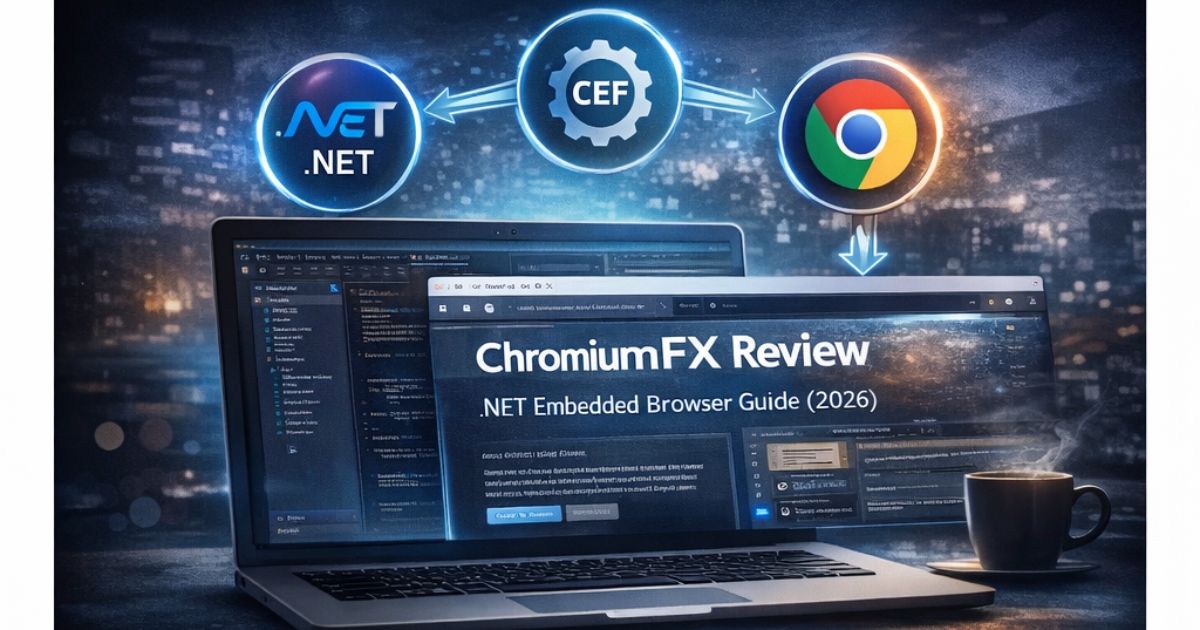
In case you are developing windows desktop software and have to incorporate a modern browser engine, inside your application, this ChromiumFX Review will assist you decision whether it is the correct choice. ChromiumFX is a.NET binding to the Chromium Embedded Framework (CEF). It enables the developers to incorporate a complete Chromium engine in the windows desktop application, particularly those written in C# and WinForms.
This guide describes the working principle, why developers adopt it, its benefits, constraints, and whether it remains a relevant tool in the contemporary development or not. In a nutshell: this ChromiumFX Review demonstrates that it serves as an intermediary between .NET applications and Chromium engine.
What Is ChromiumFX?
ChromiumFX does not serve as a user-friendly browser. It is a developer library which wraps CEF but allows .NET applications to host Chromium within them.
In simple terms:
- Chromium gives the browser engine.
- CEF enables integration of Chromium.
- ChromiumFX links CEF and .NET.
Due to this design, Windows applications are able to display HTML, CSS and JavaScript within desktop applications. In this ChromiumFX Review, we are going to discuss the technical application, but not consumer browsing applications such as chromium fastest browser builds or public downloads as chromium browser filehorse listings.
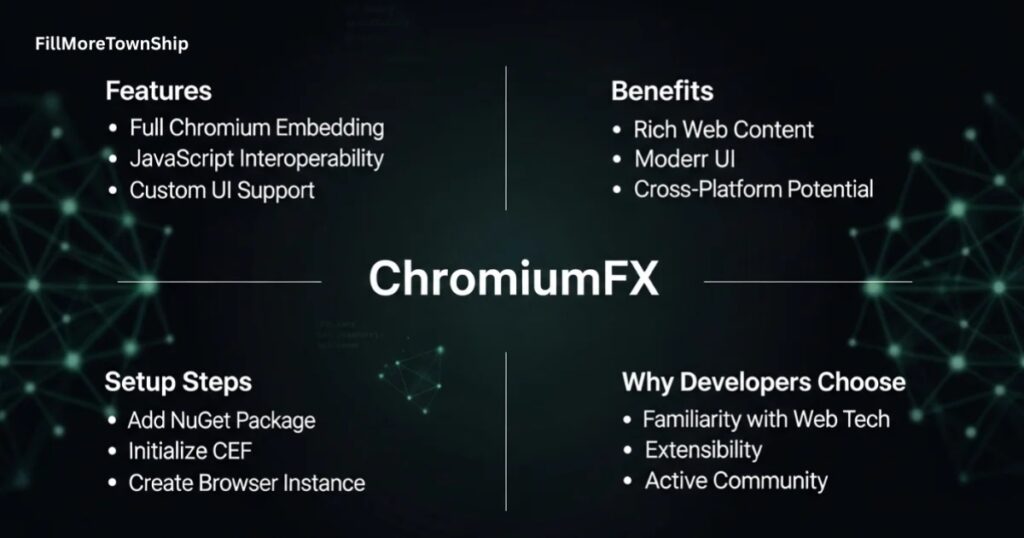
Learning the Technology Stack
The Role of Chromium
Chromium is an open-source web browser that is utilized in various browsers today. It embraces high end rendering, JavaScript and up-to-date web standards. The search results when people look about chromium fastest browser tend to be performance-optimized versions of Chromium itself – not ChromiumFX.
The CEF (Chromium Embedded Framework) Role
CEF enables the developers to embed Chromium within a different application. Software teams do not need to build a browser engine but instead use Chromium via CEF.
CEF handles:
- Rendering
- Networking
- JavaScript execution
- Browser events
The Role of ChromiumFX
ChromiumFX is the bridge of.NET. It converts CEF functionality to something that can be used by C# and other.NET languages. Without this wrapper, the developers of the .NET would find it hard to directly integrate CEF. This is the reason why this ChromiumFX Review explains its significance in the enterprise software of Windows.
The Internal Workings of ChromiumFX in a Desktop App
The process of work is organized and realistic.
Step 1: Design a .NET Application
The C# and WinForms language are used by developers to create a desktop app in Windows.
Step 2: Integrate ChromiumFX
The wrapper links the application with CEF libraries.
Step 3: Load Web Content
The browser control is powered by Chromium and it is incorporated within the app window.
Step 4: Enable Communication
C# backend logic interacts with JavaScript in the built-in browser. Because of this, the application will operate as a hybrid system – desktop performance and web flexibility.
Important Characteristics that are discussed in this ChromiumFX Review
Embedded Browser Control
A Chromium instance can be placed by the developers right into their application UI.
DOM Access
Applications may be programmatically linked to page contents.
JavaScript Execution
JavaScript functions, which are present within the embedded page, can be called by C# code.
Event Handling
Navigation, loading conditions and user interactions can be monitored.
Due to these features, this ChromiumFX Review testifies to the fact that it allows almost total control of browsers in Windows applications.
Common Use Cases
ChromiumFX is typically in usage in enterprise-level applications, not in consumer applications.
- Enterprise Dashboards: Firms present analytics display boards based on integrated web technology.
- Administrative Panels: Web-based configuration tools are loaded on internal ERP or CRM systems.
- Developer Utilities: There are development tools that cannot be supported without the full browser rendering.
- Legacy Systems: The companies that had already developed software on CEF still use it instead of having to rewrite it all.
This contrasts with other themes such as chromium trading economics that are associated with market pricing of metal chromium – not browser embedding technology.
Advantages of ChromiumFX
A balanced ChromiumFX Review should have its strengths.
- Modern Web Experience: Desktop applications embrace complete web interfaces.
- Seamless Integration: Frontend HTML and JavaScript are compatible with Backend.NET logic.
- Flexibility: Web technologies can be used to update the interfaces without amending application logic.
- Familiar Technology Stack: Web and.NET developers work collaboratively.
Restrictions and Real-World Issues
Challenges are supposed to be mentioned in every serious ChromiumFX Review.
- Version Management: CEF updates frequently. Correspondence should be ensured.
- Deployment Complexity: Configuration files and native binaries should be properly packaged.
- Windows Focus: Mainly targeted at Windows desktop programs.
- Maintenance Planning: Prior to adoption, long-term help and activity of the project must be reviewed by teams.
These are the problems associated with the embedded browsers.
ChromiumFX Review Is it relevant any more?
In the case of existing enterprise software, ChromiumFX is stable and workable.
New projects must however compare:
- Update frequency
- Community support
- Documentation quality
ChromiumFX is used as a technical embedding, as opposed to chromium browser filehorse downloads or chromium fastest browser builds that can be used by ordinary users. Conclusion in this ChromiumFX Review is obvious: it is only useful in the context of Windows-based enterprise and legacy environment.
The Modern Desktop Development and ChromiumFX
Desktop development has been transformed to hybrid architecturet native performance, web UI. ChromiumFX facilitated the adoption of this model by the NET developers earlier. Although more recent frameworks have been created, the fundamental concept is potent: incorporate a browser engine within desktop applications in order to be flexible.
This is why there are numerous developers that are seeking a secure chromium review in the process of assessing embedding solutions.
Frequently Asked Questions
Is ChromiumFX an independent browser?
No. It is a developer model which integrates Chromium within .NET applications.
Will this ChromiumFX Review be recommended to beginners?
It is more appropriate to those developers that are familiar with C# and desktop architecture.
Does it substitute Chromium or CEF?
No. It relies on CEF that relies on Chromium.
Does it have anything to do with the economics of chromium trading?
No. The term has nothing to do with software development but rather metal market pricing.
Does it have any relationship with chromium fastest browser builds?
No. ChromiumFX inserts engine; it does not make the browsing better by the people.
Final Thoughts
In this ChromiumFX Review, it can be seen that the framework has a certain yet significant part to play in the development of windows desktops. It enables apps to include a full Chromium engine, and retain business logic in.NET. In the case of enterprise systems, the internal dashboards, and older projects, it is still applicable and practical. In case of new projects, the developers need to consider the long-term support prior to adoption.
In essence, ChromiumFX acts as a bridge between Windows desktop architecture and modern web technology and that bridge still matters in the right context.