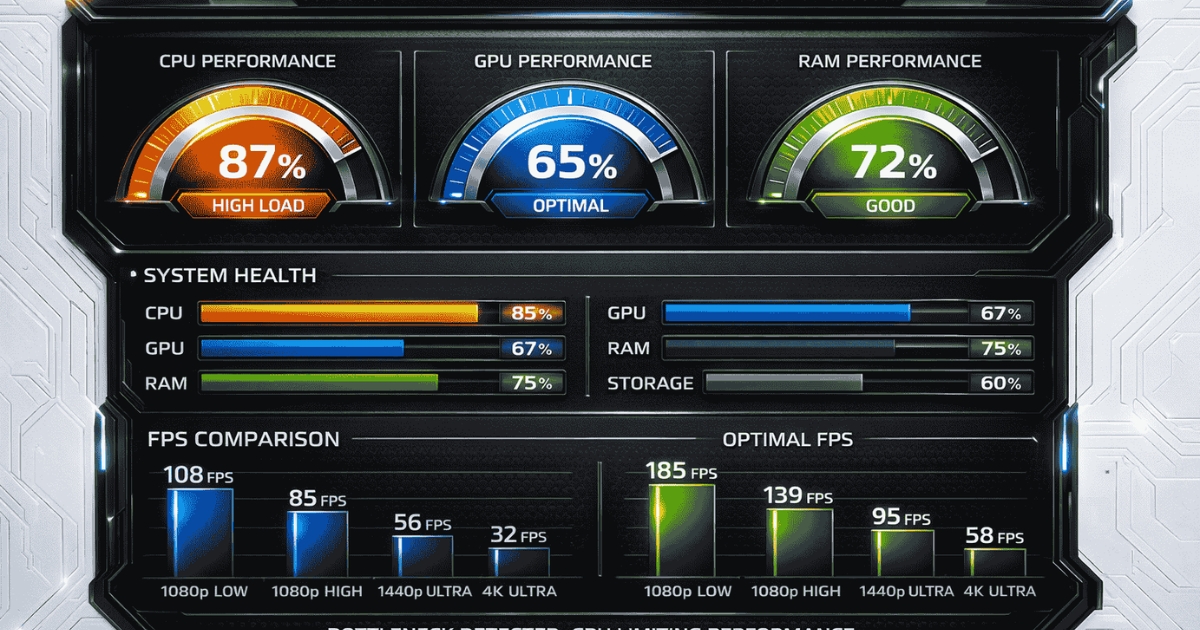
You are likely to have searched for a cpu gpu bottleneck calculator, either when assembling a PC or when upgrading one. Majority of the population desires a one-liner. They desire to know whether the CPU is overpowered by their GPU or the only thing that is slowing down the rest of the system is their GPU. That is where there is a bottleneck calculator of a CPU GPU. These utilities match your graphics card and processor to approximate which component is possibly causing performance to be constrained. Most calculator websites explain that their output is an approximation using component data, benchmarking, and game-specific data, and not a definitive verdict in the real world.
What Is a CPU GPU Bottleneck Calculator?
Online cpu gpu bottleneck calculator is a web-based tool that will verify the balance between your graphics card and processor. Its task is to approximate the strength of one component to enable it to withstand the other. A bottleneck in simple terms occurs when a certain aspect of your PC becomes a constraint to the performance of another aspect. Intel refers to PC bottleneck as a component that constrains the potential of other hardware due to the lack of compatibility in their performance levels. When someone enters a cpu gpu bottleneck calculator, he/she is essentially posing a single question:
Do I have a balanced hardware?
CPU GPU Bottleneck Calculator basics
Most calculator tools ask you to select your CPU and GPU. Others also request RAM, screen resolution or the type of activities you perform like gaming, streaming, editing or general use. The bottleneck calculator will then take the stored hardware data, benchmark comparisons, and scoring logic to approximate which part of the CPU or the GPU is most likely to be the bottleneck. Major calculator websites publicly declare that they check CPU, GPU and other component data to determine which part might be bottlenecking performance. That is helpful, but the truth is as follows: a calculator provides you with an approximate answer, not the ultimate answer.
What is Bottleneck in a PC?
A bottleneck implies that your system is not balanced. One element completes its task quickly, and the other is not able to do that. As an example, when the CPU is not in a position to handle game logic, physics, and/or draw calls quick enough, then the GPU waits. That is termed as a CPU bottleneck. When the graphics card is saturated with graphics, textures, and graphics effects but the CPU still has capacity, it is a GPU bottleneck. Both Intel and Kingston describe bottlenecks in this sense of a balanced-system. That is the reason why a cpu gpu bottleneck calculator has gained popularity. People do not want to spend money on a single strong component that cannot be utilized completely.
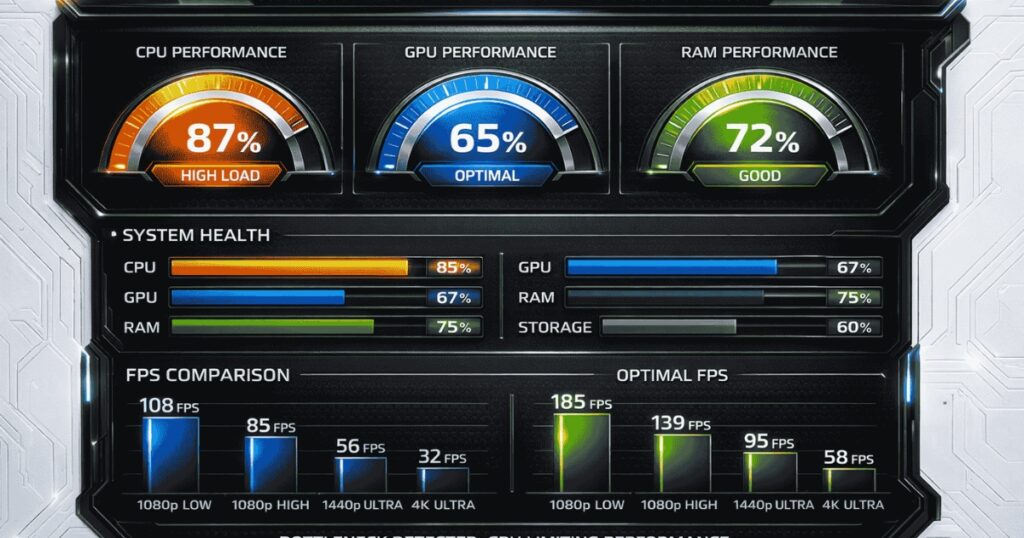
CPU Bottleneck and GPU Bottleneck
A CPU bottleneck typically occurs when the processor is not fast enough to do the job. This is found more in high-FPS games, games that are more simulation heavy or in low-resolution environments where the bottleneck is not the graphics card. A graphics card bottleneck occurs when the graphics card is completely occupied with intensive graphics, high-resolution, detailed textures, or intensive graphical effects. According to Kingston, GPU bottlenecks are typical to games that are graphically intensive and settings that demand visual quality to its limits. Even a minor bottleneck in the GPUs is not a catastrophe in most gaming systems. It usually simply means that your graphics card is doing a lot of heavy lifting, which is natural in the contemporary games.
Do CPU GPU Bottleneck Calculators Work?
This is where the majority of the articles are deceitful. Therefore, the simple solution is the following: A cpu gpu bottleneck calculator may be helpful, yet it is not entirely accurate. These are to be used in rough hardware matching, quick estimates and early planning. Even calculator sites themselves tell their results as approximations and not actual measurements in the real world.
Why so restricted?
As the actual performance is not tied to the CPU and GPU names alone. It also depends on:
- game optimization
- screen resolution
- graphics settings
- speed and size of RAM
- cooling
- background apps
- drivers
- game engine behavior
Therefore do not go using any cpu gpu bottleneck calculator as a judge passing a death sentence. Take it as a bookmark to preliminary research.
Symptoms of a Bottleneck in your PC
Not all the time do you require a calculator. It already tells you that something is wrong by your PC.
Common signs include:
- low FPS
- stuttering
- uneven frame pacing
- one component close to maximum utilization with the other significantly less
One of the largest calculator websites explicitly mentions low FPS, inconsistent performance, and one component reaching very high utilization and the other remaining significantly lower as typical indicators of a bottleneck. Another method suggested by HP is to monitor CPU and GPU performance when playing to identify this problem. When your GPU utilization is minimal and your CPU utilization is always high when playing a game, it is likely to indicate a CPU-side bottleneck. When the pinned GPU and remaining headroom of the CPU is exhausted, the graphics card is probably the bottleneck.
Why Resolution Changes Everything
Many amateurs overlook this fact. Lower resolutions such as 1080p usually are more sensitive to the CPU since the graphics card must render fewer pixels, which means the processor can be the bottleneck at a lower resolution. In the higher resolutions such as 1440p or 4K, the GPU tends to bear more of the burden since the rendering is far more intensive. The identical tendency is observed in the gaming instructions and discussions among enthusiasts, and it is consistent with the behavior of GPU-bound workloads in current games. It implies that the outcome of a cpu gpu bottleneck calculator may vary when you set up to a different resolution and settings.
Checking Bottlenecks without Calculator
An initial useful point of start is a cpu gpu bottleneck calculator, but actual testing is preferable.
This is the wiser way:
- Use the games or applications you play.
- View CPU usage, GPU usage, frame rate, and frame-time behavior.
- Then compare the behaviour at other settings.
If lowering visual settings gives you much higher FPS, the GPU was probably the main limit. If lowering settings barely helps and the CPU stays heavily loaded, the processor may be the problem. HP specifically recommends monitoring both CPU and GPU performance during gameplay to identify bottleneck behavior.
How to Fix a CPU or GPU Bottleneck
The fix depends on which part is the problem.
If the CPU is the bottleneck, you may need:
- a faster processor
- better RAM
- background process cleanup
- game setting changes that reduce CPU load
If the GPU is the bottleneck, you may need:
- lower graphics settings
- reduced resolution
- upscaling features
- a stronger graphics card
Sometimes you do not need to upgrade at all. You just need better settings. Practical tuning can reduce load in the right area and make the system feel smoother. Recent performance advice around real-world troubleshooting often points to adjusting CPU-heavy settings and GPU-heavy settings differently instead of blindly upgrading first.
Is a CPU GPU Bottleneck Calculator Worth Using?
Yes, but with the right expectation.
A cpu gpu bottleneck calculator is worth using when you are:
- planning a new PC build
- comparing upgrade options
- checking whether parts are roughly balanced
- trying to avoid obvious mismatches
It is not enough on its own for final decisions. Think of it as a first filter. It can save time, but it cannot fully replace real benchmarks and actual usage tests. That view matches both calculator-site disclaimers and broader hardware guidance on how bottlenecks really work.
FAQs
What is a CPU GPU bottleneck calculator?
It is an online tool that estimates whether your CPU or GPU may be limiting your system’s performance by comparing component data and benchmark-style information.
Is a CPU GPU bottleneck calculator accurate?
It is useful for estimates, but not fully exact. Real-world performance depends on games, settings, resolution, RAM, drivers, and other factors.
Is CPU bottleneck worse than GPU bottleneck?
Not always. A mild GPU bottleneck is common in visually demanding games. A CPU bottleneck can feel worse in high-FPS gaming because it may cause stutter and inconsistent frame times.
Should I upgrade CPU or GPU first?
Upgrade the part that is actually limiting performance in your real workload. A calculator can help you guess, but real monitoring gives a better answer.
Final Thoughts
A cpu gpu bottleneck calculator is helpful, but many people trust it too much. That is the mistake. The tool can show whether your CPU and GPU look balanced on paper. It can point you in the right direction. But it cannot fully predict how every game, app, resolution, and setting will behave on your exact system. Use a cpu gpu bottleneck calculator for quick guidance. Then verify the result with real testing. That is the only smart way to make upgrade decisions without fooling yourself.